
 Facebook
 X
X
 Pinterest
 Copy Link
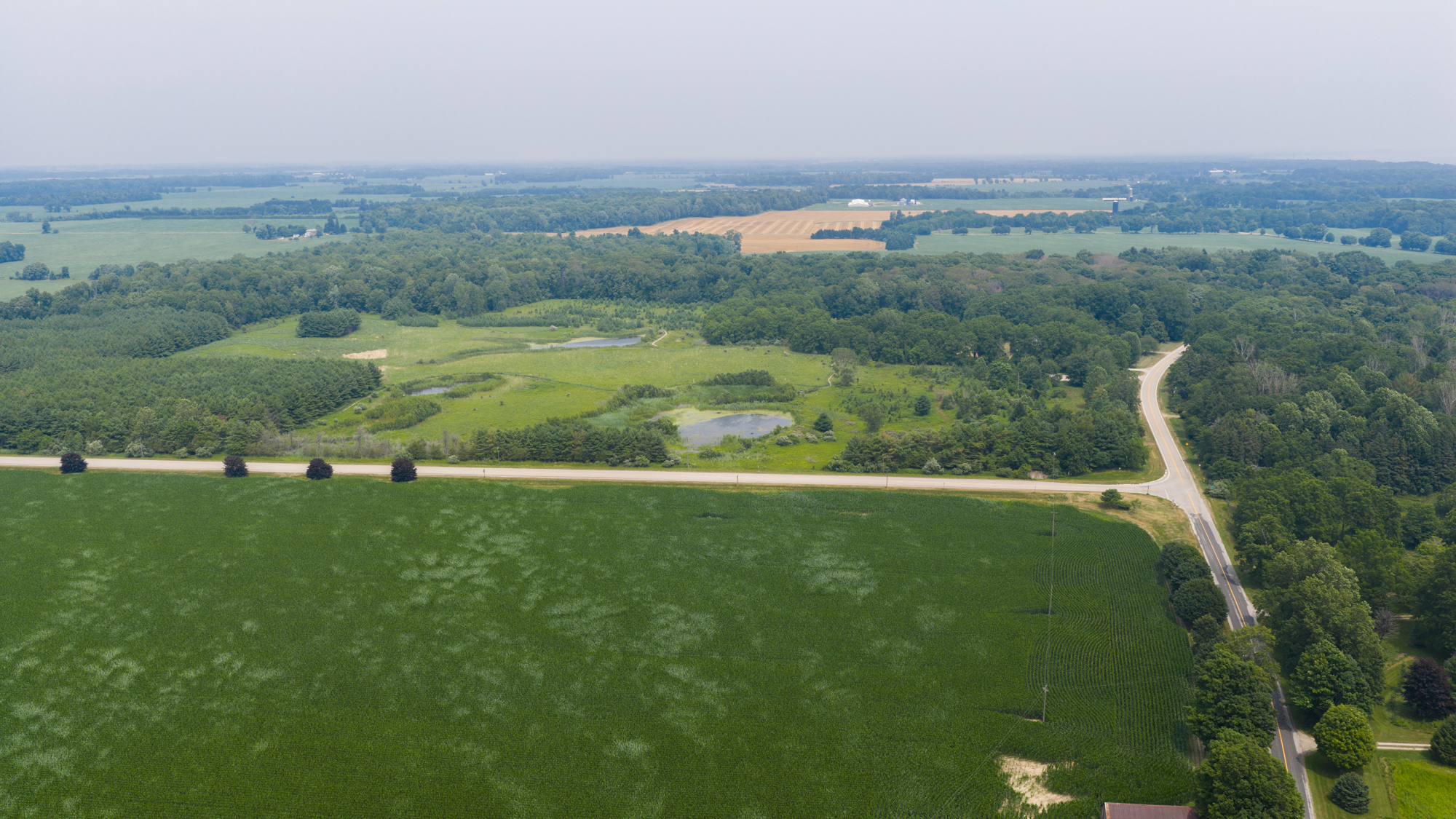
Rural Lakeview Line, Elgin County — minutes from John E. Pearce Provincial Park and the Lake Erie bluffs.
The quick answer: John E. Pearce Provincial Park is a day-use Nature Reserve on Lakeview Line near Wallacetown, on the north shore of Lake Erie. It protects roughly 68 hectares of century-old Carolinian forest, the Spicer Trail with fifteen interpretive stops, and a 33-metre bluff lookout over the lake. It is open seasonally, and there is no camping.
Most people drive past the little brown sign on Lakeview Line without realizing what’s behind it — or that the same rural road holds an estate acreage currently for sale. This is a plain-spoken guide to the park: what the trail is actually like, what you’ll see, and what to know before you go.
- Where: Lakeview Line, near Wallacetown (Dutton/Dunwich), on the north shore of Lake Erie.
- What: A ~68-hectare Nature Reserve-class park — the Spicer Trail with fifteen interpretive stops, a Lake Erie bluff lookout, restored wetlands, and the Backus-Page House Museum.
- Know before you go: Day-use only (no camping), open seasonally — in 2026, June 5 to October 12.
Where it is — and why that’s the point
John E. Pearce Provincial Park sits on Lakeview Line near Wallacetown, right where the farmland of Dutton/Dunwich meets the bluffs above Lake Erie. It’s a Nature Reserve-class park, established in 1957 and roughly 68 hectares (about 168 acres). Nature Reserve is Ontario’s most protective park class — the land is here to conserve a rare ecosystem, not to be developed, so what you walk through today looks much like it did a century ago.
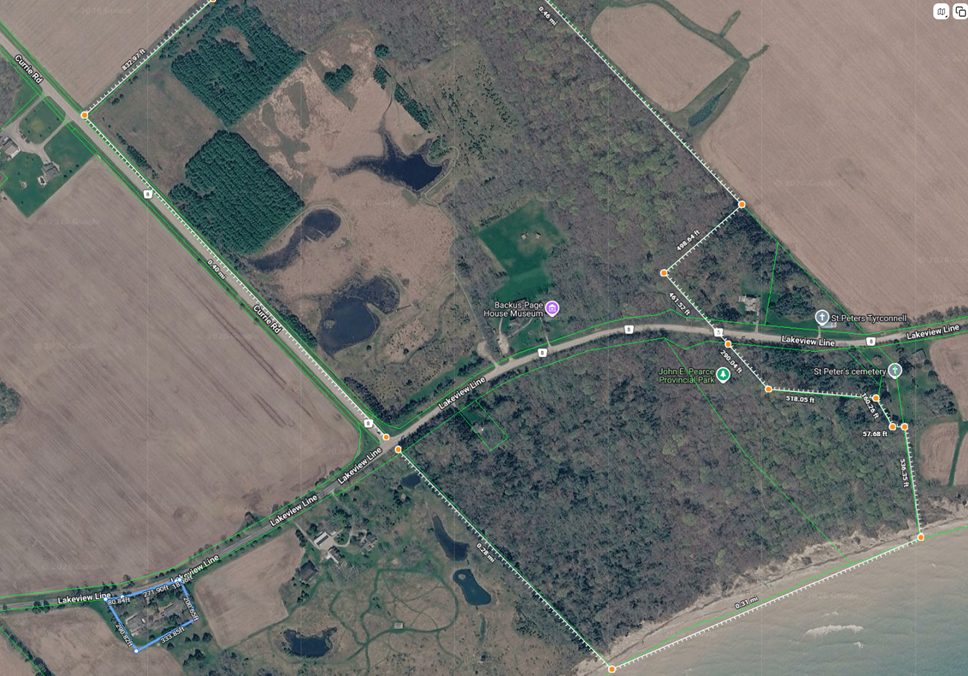
John E. Pearce Provincial Park and 29159 Lakeview Line — the same road.
Directions: View John E. Pearce Provincial Park on Google Maps »
The Spicer Trail: fifteen stops through a Carolinian forest
The main walk is the Spicer Trail — a forest path with fifteen interpretive stops that read the woods to you as you go. This isn’t ordinary Ontario bush. The park sits in the Carolinian zone, the narrow band of Southwestern Ontario that grows trees you won’t find much further north: alongside the sugar maple and American beech you’ll pass hickory, black walnut, ironwood, ash, and even tulip tree and sassafras. The hardwoods here are described as century-old, which is why the canopy feels cathedral-tall in summer and lights up in fall.
The 33-metre bluff over Lake Erie
The payoff at the edge of the forest is the lookout: a 33-metre (roughly 110-foot) cliff dropping to Lake Erie, with open water to the horizon. On a clear day it’s the kind of view most people associate with a vacation, not a Sunday walk ten minutes from home. A straightforward note of honesty: it’s a real bluff with a real drop — keep kids and dogs close to the marked viewing area and back from the edge, especially after rain.
Wetlands, birds, and a museum at the gate
Beyond the forest loop, a wetland restoration adds three wetlands, a viewing platform, and its own short trail — and the park is known for exceptional birding, so bring binoculars in spring and fall migration. At the entrance stands the Backus-Page House Museum, a restored 1850s Georgian-style home that tells the story of rural Victorian life in Elgin County. It means a single visit can be a forest walk, a lake view, and a piece of local history in one stop.
Know before you go
- Day-use only. There is no camping — this is a walk-in, spend-the-afternoon park.
- Seasonal. It operates spring through fall; the posted 2026 season runs June 5 to October 12. Confirm current hours with Ontario Parks before a shoulder-season visit.
- What to do: hiking and birding in season, snowshoeing when there’s snow.
- Bring: proper footwear for a natural forest trail, water, and a camera for the bluff.
Common questions
Can you camp at John E. Pearce Provincial Park?
No. It’s a day-use Nature Reserve park — hiking, birding, and the lookout, but no campgrounds.
Is it open year-round?
It operates seasonally; the posted 2026 season is June 5 to October 12. Winter access is limited — check Ontario Parks first.
What’s the trail like?
The Spicer Trail is a forest walk with fifteen interpretive stops leading toward the Lake Erie bluff lookout. It’s a natural-surface trail, so wear real shoes.
Is it good for birdwatching?
Yes — the park is known for exceptional birding, and the restored wetlands and Carolinian canopy draw a wide range of species.
What this looks like as a place to live
Here’s the part the guidebooks miss: some of the acreages out here share the park’s road. 29159 Lakeview Line — a 1.89-acre estate property currently for sale — sits on the same Lakeview Line, with John E. Pearce Provincial Park just minutes away and its own direct water and wildlife views. Buy rural on this road and the park isn’t a day trip; it’s the end of your street. See the full 29159 Lakeview Line listing and the rural buyer’s guide »
Thinking about life near the park?
If a place minutes from the trails and the bluffs is what you’re picturing, let’s find the one that fits — and stand in it before someone else does.
About Ken Small. Ken Small leads the Ken Small Real Estate Team with Century 21 First Canadian Corp., Brokerage, serving London, St. Thomas, and Elgin County. The team’s approach is radical transparency — answer every question honestly, hand buyers the full file, and let the truth do the selling. Reach Ken directly at (226) 271-1140.
29159 Lakeview Line, Wallacetown: An Estate on 1.89 Acres With a Workshop and a Lake View
Ken Small Real Estate Team · Century 21 First Canadian Corp., Brokerage · (226) 271-1140. Lifestyle/informational content; park details deemed reliable but not guaranteed — confirm current hours and access with Ontario Parks. Not intended to solicit buyers or sellers currently under contract.

